RECORD-002
Photographic artifact.
Reference: PH-114 / I-03.
Catalog incomplete.
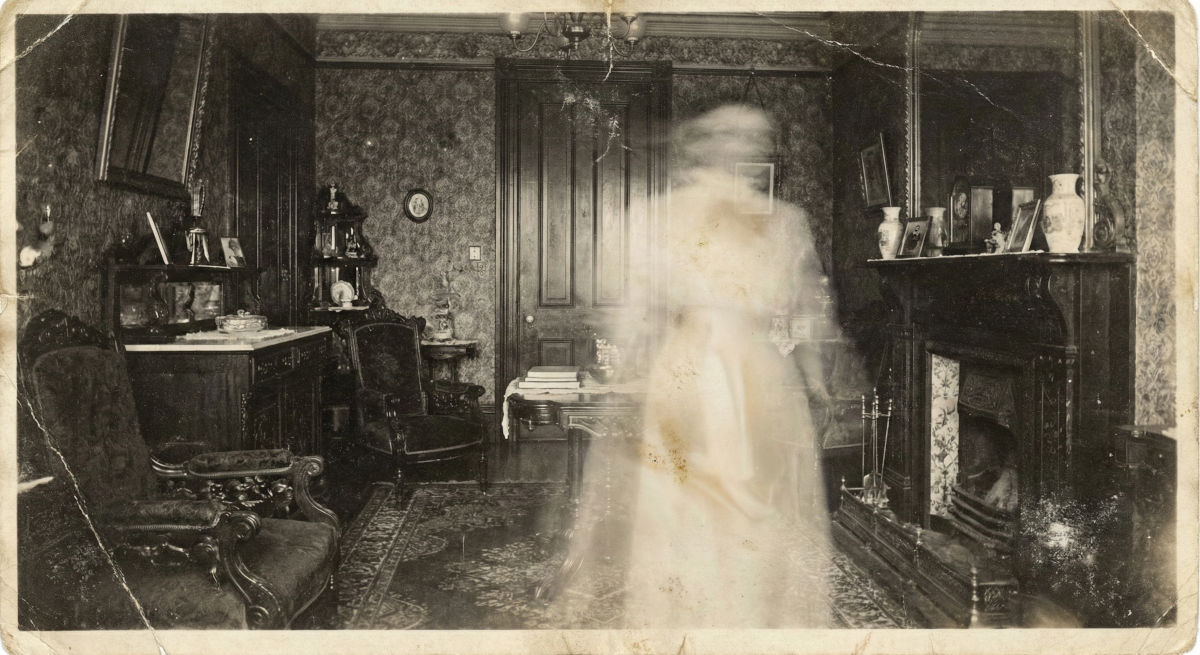
Visual Description
The image depicts a furnished domestic interior. A human figure appears centrally positioned yet lacks defined contours, producing a semi-transparent effect against sharply rendered furniture and architectural details.
No contemporary caption accompanies the print. Later references describe the figure as a “ghost photograph,” a term not present in the original material.
Technical Context
Early photographic processes often required prolonged exposure times, especially in low-light interior settings. Subjects who moved during exposure could register as blurred, incomplete, or faint forms.
Such technical artifacts—combined with limited visual literacy around photographic processes— contributed to later supernatural interpretations, even where no intentional manipulation was involved.
Historical Context — Spirit Photography
In the mid-nineteenth century, photographic artifacts resembling transparent or absent human figures began to circulate widely. One of the earliest documented cases emerged in the United States around 1862, when photographer William H. Mumler produced images containing additional, semi-visible figures.
These appearances were later attributed to technical factors such as double exposure and plate reuse. Despite this, such images gained significant popularity during the period of spiritualist movements, particularly in the aftermath of widespread civilian loss.
Although many examples were later demonstrated to involve deliberate manipulation, the visual language established by these early images persisted. Accidental photographic artifacts continued to be interpreted as evidence of spectral presence well into the late nineteenth century.
Collector’s Note
The spectral attribution appears to postdate the photograph. No verifiable annotation identifies the figure, and no evidence suggests intentional manipulation.
— The Archivist